Overview
Thirty-four rock-cut monuments representing three religious traditions.
Ellora Caves are a sequence of rock-cut monasteries and temples extending along a basalt escarpment near Verul in Maharashtra. The 34 principal monuments represent Buddhist, Hindu and Jain traditions and were created over several centuries. Their proximity makes Ellora an exceptional record of changing religious patronage, artistic exchange and technical ambition within one continuous archaeological landscape.
Rock-cut activity developed broadly between the sixth and twelfth centuries. Buddhist monasteries and worship spaces occupy the earlier part of the sequence, followed by major Brahmanical monuments and later Jain caves. The arrangement should not be read as a simple linear replacement of one faith by another; UNESCO emphasises the ensemble’s testimony to coexistence and the artistic activity of several religious communities.
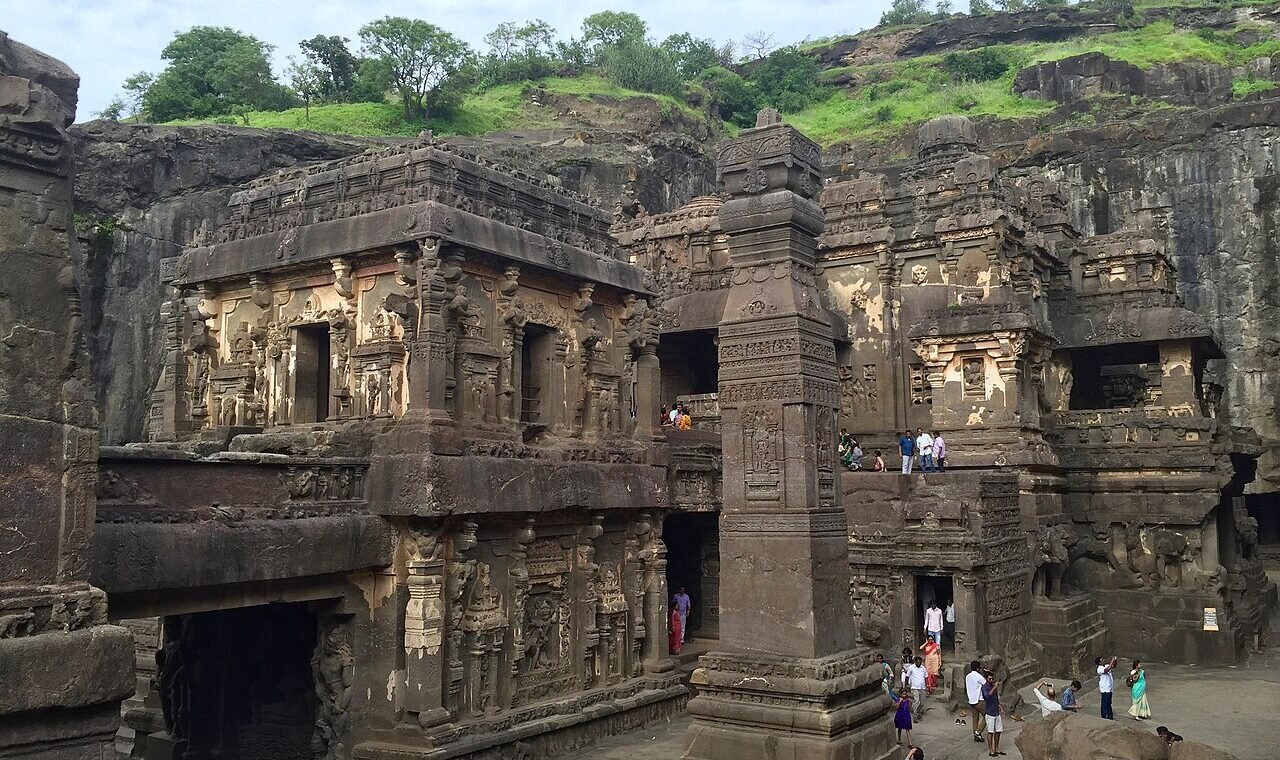
The Kailasa temple, Cave 16, is the complex’s most celebrated achievement, carved downward from living rock to create a freestanding architectural composition on a monumental scale. Other caves reward attention to multi-storeyed halls, pillars, shrines and sculptural programmes. Because the site extends for more than two kilometres, visitors must balance famous highlights with walking time and heat.
Ellora suits archaeology enthusiasts, families, photographers and travellers interested in architecture or religion. Four to six hours allow a selective but meaningful visit. Uneven surfaces and steps affect accessibility, while conservation barriers and photography rules must be respected. Current ASI hours, weekly closure and ticket categories should be checked through official channels rather than copied from undated listings.
The caves work well from Chhatrapati Sambhajinagar as a base and can be combined with nearby heritage only if sufficient time is allowed. Ajanta offers a different emphasis on Buddhist painting and should not be treated as interchangeable. Ellora’s power comes from the physical and conceptual range of its rock-cut architecture. Kailasa provides a dramatic centrepiece, while the Buddhist and Jain monuments remain equally important to understanding the complex. A slower route also reveals changing excavation techniques, spatial planning and devotional use across the complex.